

Available courses

The objectives of the Environmental Policy & Planning course are multifaceted, aiming to equip students with the knowledge, skills, and competencies necessary to address complex environmental challenges and contribute to sustainable development initiatives. Key objectives include fostering an understanding of environmental policy frameworks and governance structures at local, regional, and international level, developing analytical and critical thinking skills for evaluating environmental issues and policy solutions, enhancing technical competencies in data analysis, and other relevant tools for environmental planning and management, promoting effective communication and collaboration in interdisciplinary settings, and cultivating a sense of responsibility and commitment to environmental stewardship and social equity.
- AUTeacher: Admin User

To give the students an up to date introduction to the concept of circularity and circular economy, including bio-economy (fresh carbon-based value chains), both in Europe and globally, to allow them to identify and develop suitable circularity concepts for plausible economic models encountered in their study or work. Furthermore, the course will present the newest knowledge and an overview of the current status of metrics for quantifying circularity and the issue of scaling circular business models.
- FDTeacher: Frank Akowuge Dugasseh
- AUTeacher: Admin User


The objective of the course is to train the students within basic concepts of digital technologies in farming systems, the integration of digital tools in crop production - methods applied, data generated and data used to monitor and manage the agricultural system in front of the challenges nowadays, including the use of various metrices to evaluate crop production and environmental state. Possible approaches for improving the food systems for efficient water and nutrients use are in focus in relation to improved use of external resources to minimize reactive flows of nutrients. Students will obtain both theoretical and practical knowledge on data in agriculture, models and tools to analyze data in the context of food systems and losses from fields, farm and system level.
- AUTeacher: Admin User

The main objectives are:
- Understanding the principles of remote sensing: Develop a comprehensive understanding of the fundamentals, techniques, and applications of remote sensing technology (e.g. satellite imagery, aerial photography...etc.).
- Exploring Wireless Sensor Networks (WSNs): Introduce the concepts, architectures, and protocols of wireless sensor networks, focusing on their design, installation, and operation in different scenarios.
- Integrating remote sensing with wireless sensor networks: Explore the integration of remote sensing data with wireless sensor networks for some application examples like environmental monitoring, disaster management, precision agriculture and many other applications.
- Data acquisition and analysis: Provide valuable insight into the acquisition, processing and analysis of remotely sensed data and sensor measurements.
- AUTeacher: Admin User

Environmental Risk Assessment I provides the conceptual, methodological, and governance foundations for analysing environmental risks affecting ecosystems, society, and infrastructure. The course introduces hazard, exposure, vulnerability, consequence, and risk within internationally recognised frameworks including ISO 31000, the UN Sendai Framework, and EU risk governance.
- MLTeacher: Michal Lodin
- AUTeacher: Admin User

The main objectives are:
- to gain broad understanding of how sensors work;
- to learn the basic sensors used in precision agricultural systems and on the interpretation of data they provide;
- to gain first-hand experience on current sensor system technology implemented for different purposes and situations.
- AUTeacher: Admin User

- PPTeacher: Petr Pavlík
- FSTeacher: Filip Strnad
- AUTeacher: Admin User

- VMTeacher: Vojta Moravec
- AUTeacher: Admin User
- MVTeacher: Martin Vokoun


The objectives of this course are to:
- understand and use Czech language in a basic level, in order to respond in a variety of everyday communication situations.
- learn about Czech history and culture
- AUTeacher: Admin User


- AATeacher: Ali Abkar
- YITeacher: Yiannis Ioannidis
- AUTeacher: Admin User
- VVTeacher: Vassiliki Varela


The aim of the course IoT Platforms and Systems is to provide students with knowledge on the technologies for the design, development, and implementation of the solutions in different sectors. IoT systems are proven to build a sustainable smart distributed and centralized, edge and cloud computing, mobile and fixed, wired, and wireless applications in different sectors such as smart agriculture, smart cities, smart water, smart transport, smart utilities, and many others.
At the end of the course students will have a basic knowledge of how to work, build and enhance the systems in a sustainable and interoperable way.
- AUTeacher: Admin User



The course aims to equip each student with the necessary skills to attain the initial accreditation level of the NI LabVIEW software. Consequently, students are expected to gain familiarity with the LabVIEW environment, comprehend its fundamental components and structures, develop rudimentary applications within the LabVIEW graphical programming environment, employ the state machine design pattern for application creation, and proficiently handle data input/output operations. Furthermore, participants will grasp the advantages of LabVIEW and its application in resolving real-world environmental challenges such as Resource Management, Environmental Protection, and Pollution Monitoring.
- AUTeacher: Admin User
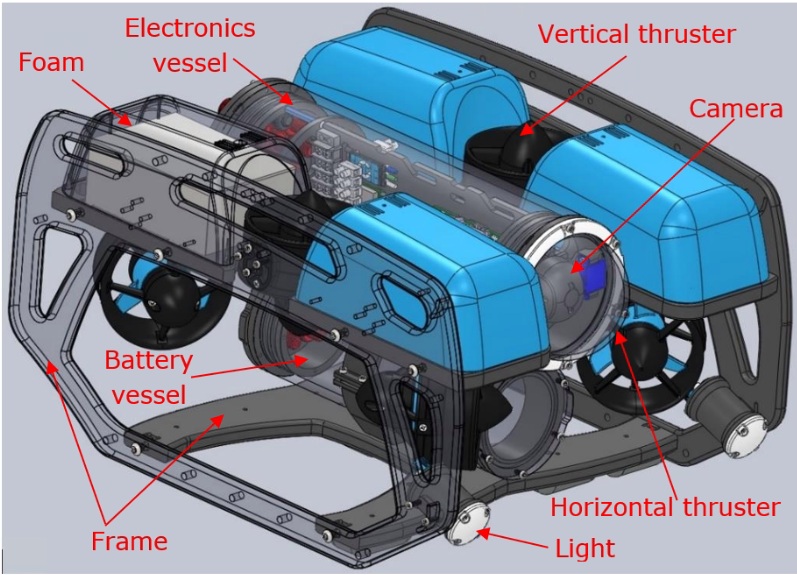
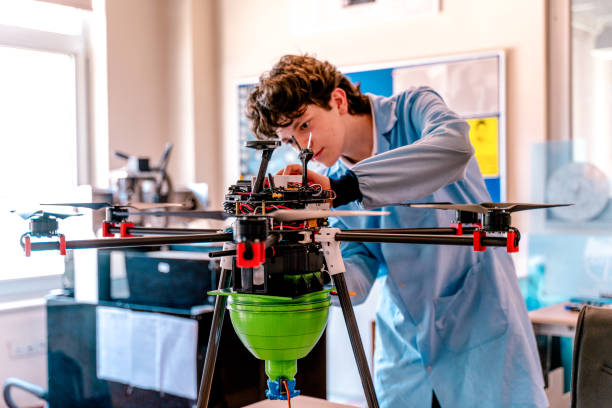
The aim of the course on drone system (remotely operated vehicles) is to provide students with knowledge on the technologies for the design, development, and implementation of drones in different sectors. The complexity of the drones require knowledge in hardware and software design, sensors, actuators, cameras, communication technologies, data structures and data transmission, motion, kinematics, data management.
At the end of the course students will have a basic knowledge of how drones work, are built and could be implemented in different applications (industrial, environmental), how the drones could be used in the integrated sustainable solutions and be interoperable with other systems.
- AUTeacher: Admin User

Information and management of the internships
- AATeacher: Ali Abkar
- HHTeacher: Hana Honsova
- HMTeacher: Hanel Martin

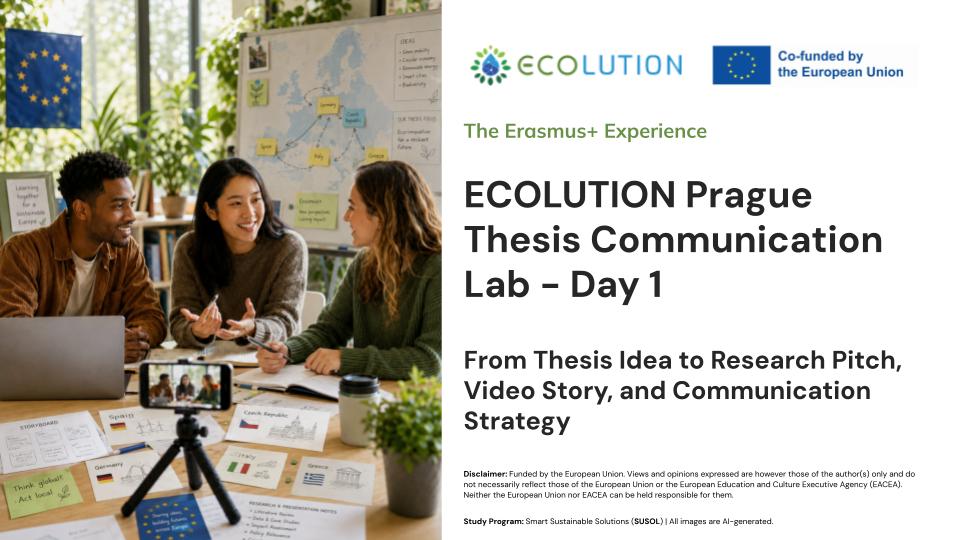
Introduction - Learning in the Spirit of Erasmus+
These activities are designed in the spirit of Erasmus+, which promotes learning through exchange, collaboration, and openness to diverse perspectives. Since its creation in 1987, the Erasmus programme has enabled students from different countries and academic fields to connect, share ideas, and develop new ways of thinking that extend beyond formal classroom instruction.
One idea often associated with the Erasmus experience is reflected in the spirit of the film L’Auberge Espagnole: each person brings their own contribution, and the richness of the experience depends on the diversity of perspectives present. In an educational context, this concept reflects a learning environment in which knowledge is not only transmitted but co-created through dialogue, interaction, and reflection.
Students will explore how their own academic interests, questions, and perspectives contribute to a shared learning environment. Rather than focusing on a single correct interpretation, the process emphasises how ideas develop when individuals engage with different viewpoints, disciplinary approaches, and cultural contexts.
The structure of the activity supports students in:
-
Recognising the value of diverse academic and personal perspectives
-
Reflecting on how ideas evolve through dialogue
-
Developing confidence in communicating research interests
-
Understanding learning as a collaborative process
-
Experiencing how European collaboration can expand individual research pathways
The methodology integrates approaches developed across several European educational initiatives, particularly in the areas of non-formal learning, reflective practice, participatory communication, and interdisciplinary collaboration. Elements of narrative reflection, dialogue-based learning, and creative communication support students in translating complex ideas into accessible forms of expression.
Structure of the 2-Day Learning Sequence
The activities are designed as a progressive learning journey moving from reflection to communication and practical application.
Day 1 - Developing the Research Narrative
Students explore how academic interests, motivations, and societal relevance can be translated into a clear research message.
Activities introduce:
-
Europe as a shared learning environment shaped through exchange
-
IKIGAI reflection connecting interests, strengths, and contribution
-
Personal Branding Statement (BB Sentence) for academic identity
-
“ECOLUTION Lens” linking research motivation, expertise, and communication context
-
Development of one Master’s Thesis Pitch, one LENS video script, and one first-take thesis reel.
Estimated duration Day 1: approx. 3 hours
Day 2 - Communicating Research through Participatory Video
Students refine their research message and apply a simple narrative structure to communicate their thesis topic clearly.
Activities introduce:
-
The Researcher’s Journey structure, inspired by The Hero’s Journey, to help students frame their thesis as a clear and engaging research story:
Call to Action → Challenge → Exploration → Exchange / Erasmus+ Moment → Insight → Contribution -
A Master’s Thesis Communication Plan, guiding students to define the purpose, audience, key message, format, tone, visual setting, privacy considerations, and intended takeaway of their video.
-
Participatory video methodology, with emphasis on ethical storytelling, respectful representation, peer support, and responsible use of images, locations, and personal data.
-
A peer-supported recording process reflecting Erasmus+ collaboration principles
-
Practical video guidance on recording vertically, choosing a meaningful location, opening with a clear research question or message, using good lighting and sound, and presenting the thesis in an accessible way.
-
Creation or improvement of a short academic video / Master’s Thesis Reel presenting the student’s thesis topic, research motivation, and potential contribution.
Estimated duration Day 2: approx. 3 hours, including video recording (approx. 2–2.5h)
Overall Learning Methodology
The ECOLUTION learning design applies a competence-based non-formal education methodology, widely used in Erasmus+ projects to support the development of transferable skills, interdisciplinary communication capacities, and reflective learning processes.
EAC adapted this approach for ECOLUTION to complement formal academic education by emphasising active participation, experiential learning, peer exchange, and the practical application of knowledge in real-world contexts.
The pedagogical framework is structured according to an adapted Bloom taxonomy for non-formal education, which distinguishes between the progressive development of Knowledge, Skills, and Attitudes. This approach enables learners to move beyond theoretical understanding toward the practical articulation of their research in formats that are accessible to diverse audiences, including interdisciplinary academic communities, innovation ecosystems, and European collaboration networks.
Learning outcomes follow adapted Bloom levels frequently applied in Erasmus+ adult education and higher education innovation projects:
Knowledge: Awareness → Comprehension → Application → Analysis → Synthesis → Evaluation → Transfer
Skills: Observation → Exploration → Assisted Practice → Independent Practice → Routine Practice → Problem Solving → Creative Modification
Attitudes: Awareness → Consideration → Imitation → Preference → Self-identification → Advocacy → Dissemination
The methodology integrates tested pedagogical approaches developed across previous European collaboration projects:
WOW-ME (Erasmus+ KA210-ADU)
Project: 2023-2-ES01-KA210-ADU-000183550
Provided the structural foundation for:
-
Competence-oriented activity design
-
Alignment of learning outcomes with ESCO skills frameworks
-
Reflective exercises connecting personal motivation with professional development pathways
-
IKIGAI-based reflection supporting articulation of individual strengths and societal contribution
-
Structured non-formal learning templates ensuring consistency across activities
HATE-LESS (Erasmus+)
Project: 2024-1-DE04-KA220-YOU-000244181
Contributed methodological inspiration related to:
-
Participatory communication approaches
-
Participatory video production
-
Inclusive dialogue structures
-
Collaborative reflection methodologies
-
Learner-centred co-creation processes supporting active knowledge exchange
The participatory video approach applied in ECOLUTION draws from these practices by enabling learners to translate academic research into concise, accessible narratives that can be shared across disciplinary and cultural boundaries.
BB Sentence (EAC & 28DIGITAL collaboration)
https://ea.consulting/generative-ai-in-personal-branding-ea-x-eit-digital/
The BB Sentence (Brief Branding Sentence) framework was developed through collaboration between Evolutionary Archetypes Consulting (EAC) and 28DIGITAL (formerly EIT Digital), focusing on structured communication of expertise, innovation capacity, and research contribution.
The BB Sentence supports learners in articulating:
-
The focus of their research
-
The competences applied in their work
-
The potential societal, technological, or scientific contribution of their research
This structured communication approach facilitates clarity across academic presentations, research networking contexts, and interdisciplinary collaboration environments.
- AUTeacher: Admin User
